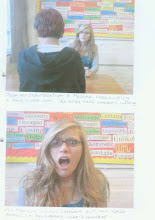
Charlie Brookers Newswipe:
Absoloute lol (see the meme i got in there) i love this, it's so funny!
The aim of Newswipe is to expose the inner workings of news media. The series is a comic, thoughtful and acerbic analysis of recent news coverage. Newswipe also looks at the way the news is presented to the public. Experts are on hand to pick apart certain stories and analyse the news media's obsessions.
-This is intertexual as the texts meaning is derived from other texts.
It parodies the news and urges the audience to interact and engage rather then sit there and be passive.
-It remixes culture, we see a typic set up of BBC news, not only does this make it hyperreal (as it almost seems real, how ever it's a representation of a representation!) but it shows how there are no new styles any more and it mostly a remix of old styles.
-It undemines authority as the News is generally something highly respected. However it shows breaking down of news values, showing quite a nihilistic view.
500 Days of Summer:
Best Rom Com out there really, it's classy, well made film, which has an orignal narrative and a quirky style.
-Plays with narrative conventions of time and space with a non linear narrative, umped around, starts at the end.
- Nihilistic, 'This is not a love story, it's a story about love'. Summer says how she doesn't believe in love. Little values. Different to normal conventions of a Rom Com.
-Intertexuality- Sid and Nancy references. More references to this with viral video of them acting a scene from this film.
-Irony- The Smiths, quite depressing band, ironic as it's a band that brings them together= happiness (for a while at least)
-Parody- Disney cartoon bird- intertexual and funny.
- Feminism- tables turned.
-Genres blurred: not a love story.
-Bricolage- lots of different bit of other types of filming put in for example, informational video and other black and white scenes.
Monday, 22 March 2010

Grand narrative
Metanarratives are thought to be a comprehensive explanation of historical experience or knowledge. They are grand, large-scale theories and philosophies of the world, such as the progress of history, the knowability of everything by science, and the possibility of absolute freedom. Therefore, a metanarrative is a story about a story, encompassing and explaining other 'little stories' within schemes.
According to postmodernism, metanarratives have lost their power to convince – they are, literally, stories that are told in order to legitimise various versions of "the truth" and we now ceased to believe that narratives of this kind are adequate to represent and contain us all. We have become alert to difference, diversity, the incompatibility of our aspirations, beliefs and desires, and for that reason postmodernity is characterised by an abundance of micronarratives.
We now focus on specific local contexts as well as the diversity of human experience.
According to postmodernism, metanarratives have lost their power to convince – they are, literally, stories that are told in order to legitimise various versions of "the truth" and we now ceased to believe that narratives of this kind are adequate to represent and contain us all. We have become alert to difference, diversity, the incompatibility of our aspirations, beliefs and desires, and for that reason postmodernity is characterised by an abundance of micronarratives.
We now focus on specific local contexts as well as the diversity of human experience.
Sunday, 21 March 2010
The Wire
The Wire is an American television drama series, each season focuses on a different facet of the city of Baltimore. There are seasons on the illegal drug trade, the port system, the city government and bureaucracy, the school system, and the print news media. It focuses on how institutions have an effect on individuals, wether you're a cop, a longshoreman, a drug dealer, a politician, a judge or a lawyer, must contend with whatever institution you've committed to.
The show is not postmodern in terms of style or aesthetics, but focuses on postmodern society in which life is meaningless and huge cooperations and institutions dominate the world in the capitalist system. We can link this to Buadrillard's work on the power of the system over us and also link it to the matrix as it tackles similar themes.
The next series is about the media, which is fitting!
The show is not postmodern in terms of style or aesthetics, but focuses on postmodern society in which life is meaningless and huge cooperations and institutions dominate the world in the capitalist system. We can link this to Buadrillard's work on the power of the system over us and also link it to the matrix as it tackles similar themes.
The next series is about the media, which is fitting!
Monday, 22 February 2010
1b) "The concept of narrative is essential to media". In what ways did you use narrative in the construction of your media product?
Our film @ccidentally in Love is a romantic comedy. Romantic comedies are movies with light-hearted, humorous dramatic stories centred on romantic ideals such as a "true love" or the "perfect couple." Romantic comedy films are a sub-genre of comedy films as well as of romance films.
One of the conventions of romantic comedy films is the encounter of two partners in unusual or comic circumstances, known as the 'meet cute' situation. In our film we have developed quite an individual 'meet cute' situation where they meet over the Internet by chance after Rob's friend makes him an account. Therefore when meeting each other in really life it leads to quite comic circumstances in order to cover up the lies they have told each other.
The film has morals and ideologies, strong elements of a narrative, that believe in true love and having faith that love will conquer all. This is shown as, stereotypically, the characters have to fight to make sure their relationship works out. It all works out in the end and, of course, there is a happy ending.
Our text as a trailer has a strong sense of narrative with the beginning making it very obvious the two characters meet on the internet, showing them both with their laptops and intertexuality of the websites help move the narrative along. Also well as this the voice over narration from the main character, Lucy, helped introduce the audience to her feelings about the character Ben. The dialogue gave a chance to introduce both her friends but also move the pitch along, letting Lucy explain to the audience what was going on through the use of making her chat to her friends.
After this the montage of different shots of things like dates and moments in the film showing different emotions, lets the audience know quickly the kinds of things that happens in this film. Obviously as it's just a trailer there is a bit of a broken narrative, we cannot unravel the whole film into two minutes. Therefore little shots showing contrasting scenes are nice as they let the audience know what's in store. As well as this the settings of a lot of the scenes are outside, giving an autunmy feel and setting the mis en scene for the film as well. The shots inside let the audience know that the film has different settings too.
The typical structure of a Rom Com is often to have something funny at the end of the trailer to end it on a high and make it memorable. We at first had a shot of Lucy walking into a glass door, however this looked unprofessional so we chose to use a clip of her dancing. This is great as it ends the trailer nicely and lets the audience know that feel good things happen in this film, possibly pulling them into wanting to know more about the narrative.
One of the conventions of romantic comedy films is the encounter of two partners in unusual or comic circumstances, known as the 'meet cute' situation. In our film we have developed quite an individual 'meet cute' situation where they meet over the Internet by chance after Rob's friend makes him an account. Therefore when meeting each other in really life it leads to quite comic circumstances in order to cover up the lies they have told each other.
The film has morals and ideologies, strong elements of a narrative, that believe in true love and having faith that love will conquer all. This is shown as, stereotypically, the characters have to fight to make sure their relationship works out. It all works out in the end and, of course, there is a happy ending.
Our text as a trailer has a strong sense of narrative with the beginning making it very obvious the two characters meet on the internet, showing them both with their laptops and intertexuality of the websites help move the narrative along. Also well as this the voice over narration from the main character, Lucy, helped introduce the audience to her feelings about the character Ben. The dialogue gave a chance to introduce both her friends but also move the pitch along, letting Lucy explain to the audience what was going on through the use of making her chat to her friends.
After this the montage of different shots of things like dates and moments in the film showing different emotions, lets the audience know quickly the kinds of things that happens in this film. Obviously as it's just a trailer there is a bit of a broken narrative, we cannot unravel the whole film into two minutes. Therefore little shots showing contrasting scenes are nice as they let the audience know what's in store. As well as this the settings of a lot of the scenes are outside, giving an autunmy feel and setting the mis en scene for the film as well. The shots inside let the audience know that the film has different settings too.
The typical structure of a Rom Com is often to have something funny at the end of the trailer to end it on a high and make it memorable. We at first had a shot of Lucy walking into a glass door, however this looked unprofessional so we chose to use a clip of her dancing. This is great as it ends the trailer nicely and lets the audience know that feel good things happen in this film, possibly pulling them into wanting to know more about the narrative.
1a) Explain how you used digital technology to adhere to or deviate from the conventions of real media texts?
When planning our film we had multiple ideas in mind to use digital technology to adhere to the conventions of a romantic comedy film. Some we managed and some we weren't quite able to do as, ironically, we didn't have digital technology that was high tech enough.
Our trailer for @ccidentally in Love used the song Watch the Sun Come Up, by the artist Example. This is because it is a feel good song with a fun vibe. It has a strong feeling of romance about it that fits our film perfectly. As well as this is also a popular song. As our Film is a Rom com it's most likely directed at a mainstream audience, therefore choosing a popular song that they would have heard, is a good idea as it increases the chance them liking it and wanting to watch more of it. We did however have to edit this song a little, but this was because we were using yet more digital technology in order to adhere to real media texts...this was the well-known trick of a voice over introduction. We used Garage Band, a sound-editing program on the apple macs to, make certain parts of the song a little quieter when we had narration voice-overs and also for when we had dialogue. This was not a difficult task, and we made sure they were nicely faded in and out gradually giving it a professional edge. After the dialogue we then faded it up gradually but really well. The point in which we were doing this in this song was perfect as it was a small interlude in which the song was naturally meant to get louder. It was also leading up to the chorus of the song, this was great as it was the start of a new part of our trailer where we have a montage of Lucy and Ben smiling and on dates etc, all very typical of a Rom Com trailer.
To record the voice over we just used the Apple Macs, this was very easy process and wasn't too difficult. It's always very conventional for romantic comedies to have an introductory voice over as it sets the feel for the movie. Therefore taking the opportunity of the technology we had to do this was great.
As the song we used was a huge feature in our trailer we really tailored the editing to it, this makes it feel and look like there is a lot of effort put into it, which is very professional feeling. There is a point at the start where we completely edit to the beat of the music, just 0.1 seconds a shot. The shot moves up her arm, there are quick flashes of her hands typing in-between this. This it a very quick thing and it goes perfectly with the music, in which there is a particularly quick beat. It's a quirky introduction, with a professional edge. Really including the song, heightens it's meaning and relates it more to the movie, this is something a lot of real media texts do and it increases publicity as that one song is going to remind people of the film and how they fit together well. A real life example of this is the song Sweet Disposition, used in the trailer for 500 Days of summer. The song was used for all the trailers and in the film too with a lot of the shots edited to the music. After a while it became instantly recognisable as 'the song used on 500 Days of Summer'. We took a lot of inspiration from this film and felt embracing a good song choice was one of them.
There was one amazing thing that we wanted to do, but our level of digital technology in school did not let us, this was the famous split screen effect. We wanted to use this to show both Helena, Ingrid’s and Lucy's faces all looking shocked, all on the same screen but Lucy as the main feature. This is used in many film trailers as it lets you fit a many characters in as possible in such little time. It's also a really fancy feature that looks great and professional. Unfortunately we could not do this on the apple macs, as the program we have isn't the most advanced. This was shame, but we don’t feel it took anything away in particular from our trailer; it just would have been great in creating the effect of a real life trailer.
Our trailer for @ccidentally in Love used the song Watch the Sun Come Up, by the artist Example. This is because it is a feel good song with a fun vibe. It has a strong feeling of romance about it that fits our film perfectly. As well as this is also a popular song. As our Film is a Rom com it's most likely directed at a mainstream audience, therefore choosing a popular song that they would have heard, is a good idea as it increases the chance them liking it and wanting to watch more of it. We did however have to edit this song a little, but this was because we were using yet more digital technology in order to adhere to real media texts...this was the well-known trick of a voice over introduction. We used Garage Band, a sound-editing program on the apple macs to, make certain parts of the song a little quieter when we had narration voice-overs and also for when we had dialogue. This was not a difficult task, and we made sure they were nicely faded in and out gradually giving it a professional edge. After the dialogue we then faded it up gradually but really well. The point in which we were doing this in this song was perfect as it was a small interlude in which the song was naturally meant to get louder. It was also leading up to the chorus of the song, this was great as it was the start of a new part of our trailer where we have a montage of Lucy and Ben smiling and on dates etc, all very typical of a Rom Com trailer.
To record the voice over we just used the Apple Macs, this was very easy process and wasn't too difficult. It's always very conventional for romantic comedies to have an introductory voice over as it sets the feel for the movie. Therefore taking the opportunity of the technology we had to do this was great.
As the song we used was a huge feature in our trailer we really tailored the editing to it, this makes it feel and look like there is a lot of effort put into it, which is very professional feeling. There is a point at the start where we completely edit to the beat of the music, just 0.1 seconds a shot. The shot moves up her arm, there are quick flashes of her hands typing in-between this. This it a very quick thing and it goes perfectly with the music, in which there is a particularly quick beat. It's a quirky introduction, with a professional edge. Really including the song, heightens it's meaning and relates it more to the movie, this is something a lot of real media texts do and it increases publicity as that one song is going to remind people of the film and how they fit together well. A real life example of this is the song Sweet Disposition, used in the trailer for 500 Days of summer. The song was used for all the trailers and in the film too with a lot of the shots edited to the music. After a while it became instantly recognisable as 'the song used on 500 Days of Summer'. We took a lot of inspiration from this film and felt embracing a good song choice was one of them.
There was one amazing thing that we wanted to do, but our level of digital technology in school did not let us, this was the famous split screen effect. We wanted to use this to show both Helena, Ingrid’s and Lucy's faces all looking shocked, all on the same screen but Lucy as the main feature. This is used in many film trailers as it lets you fit a many characters in as possible in such little time. It's also a really fancy feature that looks great and professional. Unfortunately we could not do this on the apple macs, as the program we have isn't the most advanced. This was shame, but we don’t feel it took anything away in particular from our trailer; it just would have been great in creating the effect of a real life trailer.
Moving on in the world...to the hyperreal land of PROJECT EVALUATION.
Cool. So we're moving on to project evaluation the second section of our exam ..if you would like to see the process of our project then the blog for that is http://lizzyhelena.blogspot.com/ . We have done a trailer for a Rom Com called @ccidentally in Love.
Sunday, 17 January 2010
Post-modern Precis
Play-plays with the genre conventions etc. Also a sense of play, makes it quite funny, they do not take themselves seriously.
Aesthetics- They way it looks. Could look different or similar to another production as if it is mimicking it.
Intertexuality-referencing other texts or media forms to enable meaning to be made.
Nihilistic- total rejection of established laws and institutions.
Parody-A text which doesn't simply imitate the style of another, but instead mocks or shifts the original texts conventions in some way.
Irony- Presenting something to mean something very different from what they appear on the surface to mean. This is used humorously.
Pastiche- Directly imitating a style of another text.
Eclectism- Drawing upon multiple style or genres. Often contrasting.
Self-referential- Refers to themselves.
- Rejects the idea that one media product can be more valued than the other. Anything can be art, culture has ‘eaten’ itself and there is no longer anything new to produce or distribute. Which is why there is so much intertexuality in media products today.
- The distinction between media and reality has collapsed. We now live in state of simulacrum, reality defined by images and representations.
- Ideas of truth are just competing discourses; the one we believe to be true is just the wining discourse for that moment in time.
- Hyperreality, using intertexuality and self-references breaks the rules of realism by exploring the nature of their own status as a constructed text, seeking not to represent reality, but media reality. No distinction between reality and what’s been represented. Baudrillard believes there is no longer any ‘original’ thing to represent; we live in a society made up of simulacra. Pure reality is thus replaced by hyperreal, where the boundaries of real and imaginary are eroded.
- There are many examples of Post-modern media on this blog for example The Matrix, Michael Winterbottom films, Coen brothers films.
- Michael Winterbottom: Offers films with fictionalised versions of real life, or docudramas, breaking the fourth wall. To some extent he mocks post-modern media, but this approach keeps up with postmodernism as the audience is in on the joke.
- The Coen brothers: Famous for intertexuality. Lots of pastiche and hybrid elements, for example characters often seen watching TV shows. Lots of irony and the effect that cinema is recycling itself.
- Post-modern TV: The Mighty Boosh, eclectic mix of conventions, influences and genre traits that make it impossible to product it to any one style, a form of bricolage. Ricky Gervais, The Office and Extras, self-reflective approach, Docusoap convention, pathos.
- Post-modern soap operas: Echo Beach and Moving Wallpaper. To be expanded.
- The Cadbury Gorilla.
Aesthetics- They way it looks. Could look different or similar to another production as if it is mimicking it.
Intertexuality-referencing other texts or media forms to enable meaning to be made.
Nihilistic- total rejection of established laws and institutions.
Parody-A text which doesn't simply imitate the style of another, but instead mocks or shifts the original texts conventions in some way.
Irony- Presenting something to mean something very different from what they appear on the surface to mean. This is used humorously.
Pastiche- Directly imitating a style of another text.
Eclectism- Drawing upon multiple style or genres. Often contrasting.
Self-referential- Refers to themselves.
- Rejects the idea that one media product can be more valued than the other. Anything can be art, culture has ‘eaten’ itself and there is no longer anything new to produce or distribute. Which is why there is so much intertexuality in media products today.
- The distinction between media and reality has collapsed. We now live in state of simulacrum, reality defined by images and representations.
- Ideas of truth are just competing discourses; the one we believe to be true is just the wining discourse for that moment in time.
- Hyperreality, using intertexuality and self-references breaks the rules of realism by exploring the nature of their own status as a constructed text, seeking not to represent reality, but media reality. No distinction between reality and what’s been represented. Baudrillard believes there is no longer any ‘original’ thing to represent; we live in a society made up of simulacra. Pure reality is thus replaced by hyperreal, where the boundaries of real and imaginary are eroded.
- There are many examples of Post-modern media on this blog for example The Matrix, Michael Winterbottom films, Coen brothers films.
- Michael Winterbottom: Offers films with fictionalised versions of real life, or docudramas, breaking the fourth wall. To some extent he mocks post-modern media, but this approach keeps up with postmodernism as the audience is in on the joke.
- The Coen brothers: Famous for intertexuality. Lots of pastiche and hybrid elements, for example characters often seen watching TV shows. Lots of irony and the effect that cinema is recycling itself.
- Post-modern TV: The Mighty Boosh, eclectic mix of conventions, influences and genre traits that make it impossible to product it to any one style, a form of bricolage. Ricky Gervais, The Office and Extras, self-reflective approach, Docusoap convention, pathos.
- Post-modern soap operas: Echo Beach and Moving Wallpaper. To be expanded.
- The Cadbury Gorilla.
Thursday, 17 December 2009
Simulacra/crum
Simulacra and Simulation is an idea by Jean Baudrillard that discusses the interaction between reality, symbols and society.
The defination is most known for its discussion of images, signs, and how they relate to the present day. Baudrillard claims that the modern day wrold and society has replaced all reality and meaning with symbols and signs, and that we live in a simulation of reality rather than reality itself.
Baudrillard believes that the signs of culture and media create a perceived reality; leading to society to become so reliant on simulacra that it has lost contact with the real world on which the simulacra are based.
Television, film, print and the Internet, are said to be responsible for blurring the line between goods that are needed and goods for which a need is created by commercial images.
The Matrix makes many connections to Simulacra and Simulation. Simulacra and Simulation is the book in which Neo hides his illicit software. Morpheus also refers to the real world outside of the Matrix as the "desert of the real".

The defination is most known for its discussion of images, signs, and how they relate to the present day. Baudrillard claims that the modern day wrold and society has replaced all reality and meaning with symbols and signs, and that we live in a simulation of reality rather than reality itself.
Baudrillard believes that the signs of culture and media create a perceived reality; leading to society to become so reliant on simulacra that it has lost contact with the real world on which the simulacra are based.
Television, film, print and the Internet, are said to be responsible for blurring the line between goods that are needed and goods for which a need is created by commercial images.
The Matrix makes many connections to Simulacra and Simulation. Simulacra and Simulation is the book in which Neo hides his illicit software. Morpheus also refers to the real world outside of the Matrix as the "desert of the real".

Bricolage
“Bricolage” is a French word that means putting something together out of available scraps of ideas etc to make a new piece of media art. It is related to pastiche..
' In his work, "Postmodernism and Consumer Society," Jameson writes that pastiche is "the imitation of a peculiar or unique style, the wearing of a stylistic mask, speech in a dead language" (16). He continues by describing those who work with bricolage:
"The writers and artists of the present day will no longer be able to invent new styles and worlds - they've already been invented; only a limited number of combinations are possible; the unique ones have been thought of already. ... This means that contemporary or postmodern art is going to be about art itself in a new kind of way; even more, it means that one of its essential messages will involve the necessary failure of art and the aesthetic, the failure of the new, the imprisonment in the past" (18). '
Examples of bricolage are
Music often takes the form of sound collage, as well as sampling, DJs do this alot, mixing new and old songs, from all types of genres.

Film Quentin Tarantino's Kill Bill relies heavily on styles, genres and codes from a variety of sources. He uses elements from Hong Kong kung-fu films, grindhouse style fight scenes and comic book set-ups.

Another film example is The Matrix by the Wachowski brothers, it visualually incorporates lots of different influences and styles into a new film. They draw on genres, stories and visuals such as the fantasy world of Alice in Wonderland, Japanese cyberpunk manga from Ghost in the Shell, action comic books, and kung-fu movies. Much of the discourse within the film refers to ,and combines, the ideas of Jacques Lacan, Jean Baudrillard, as well as lots of religious influences too.

' In his work, "Postmodernism and Consumer Society," Jameson writes that pastiche is "the imitation of a peculiar or unique style, the wearing of a stylistic mask, speech in a dead language" (16). He continues by describing those who work with bricolage:
"The writers and artists of the present day will no longer be able to invent new styles and worlds - they've already been invented; only a limited number of combinations are possible; the unique ones have been thought of already. ... This means that contemporary or postmodern art is going to be about art itself in a new kind of way; even more, it means that one of its essential messages will involve the necessary failure of art and the aesthetic, the failure of the new, the imprisonment in the past" (18). '
Examples of bricolage are
Music often takes the form of sound collage, as well as sampling, DJs do this alot, mixing new and old songs, from all types of genres.

Film Quentin Tarantino's Kill Bill relies heavily on styles, genres and codes from a variety of sources. He uses elements from Hong Kong kung-fu films, grindhouse style fight scenes and comic book set-ups.

Another film example is The Matrix by the Wachowski brothers, it visualually incorporates lots of different influences and styles into a new film. They draw on genres, stories and visuals such as the fantasy world of Alice in Wonderland, Japanese cyberpunk manga from Ghost in the Shell, action comic books, and kung-fu movies. Much of the discourse within the film refers to ,and combines, the ideas of Jacques Lacan, Jean Baudrillard, as well as lots of religious influences too.

Wednesday, 2 December 2009
Meme
A meme is an idea or creative item that is passed on virally from person to person to the point where lots of people know about it and are talking about. It's a cultural item that is transmitted by repetition in a manner similar to the biological transmission of genes when going through evolution. It can be explained in evolutionary principles when explaining the spread of ideas and cultural phenomena. For example memes develop through natural selection, similar to that of biolgical evolution. They go through variation, mutation and competition, through plenty of different people or texts.
Examples of memes include melodies, catch-phrases, beliefs, clothing fashion and most of all internet memes. Internet memes are often catchphrases or concepts that spread quickly from person to person via the Internet, much like an inside joke.

Examples of memes include melodies, catch-phrases, beliefs, clothing fashion and most of all internet memes. Internet memes are often catchphrases or concepts that spread quickly from person to person via the Internet, much like an inside joke.

Friday, 27 November 2009
The Coen Brothers
Joel David Coen and Ethan Jesse Coen, known together professionally as the Coen brothers, are American filmmakers, who write and direct their films jointly. The pair have written and directed numerous successful films, ranging comedies (O Brother, Where Art Thou?, Raising Arizona, The Hudsucker Proxy) to thrillers (Miller's Crossing, Blood Simple, The Man Who Wasn't There, No Country for Old Men), to postmodern movies where the genres blur together (Barton Fink, Fargo, The Big Lebowski, Burn After Reading, and A Serious Man).
Combining eccentricity, humor, irony, and often brutal violence, the films of the Coen brothers are still a style of filmmaking that pays tribute to classic American movie genres, especially film noir, while sustaining a postmodern feel. An example of one of their postmodern films is Barton Fink:
- This film is seen as postmodern because it crosses genres, fragments the characters' experiences, and doesn't have straightforward narrative.
-It's described as a "postmodern pastiche" which closely examines how past eras have represented themselves. It's an ironic reexamination of history as it is both a critique of the Hollywood system then and now, but also a reworking of the myth of the leftist artist in the 1930s.
It contains a mix of history and pure fiction. A similar methodology is adopted for 'O Brother, Where Art Thou?' which offers a precise recreation of 1930s deep-south America but frames the narrative using Homer's The Odyssey. The mixture of historical detail with fiction narrative is incredibly postmodern as it's playing with conventions.
Combining eccentricity, humor, irony, and often brutal violence, the films of the Coen brothers are still a style of filmmaking that pays tribute to classic American movie genres, especially film noir, while sustaining a postmodern feel. An example of one of their postmodern films is Barton Fink:
- This film is seen as postmodern because it crosses genres, fragments the characters' experiences, and doesn't have straightforward narrative.
-It's described as a "postmodern pastiche" which closely examines how past eras have represented themselves. It's an ironic reexamination of history as it is both a critique of the Hollywood system then and now, but also a reworking of the myth of the leftist artist in the 1930s.
It contains a mix of history and pure fiction. A similar methodology is adopted for 'O Brother, Where Art Thou?' which offers a precise recreation of 1930s deep-south America but frames the narrative using Homer's The Odyssey. The mixture of historical detail with fiction narrative is incredibly postmodern as it's playing with conventions.
Wednesday, 25 November 2009
Hyperreality
Hyperreality is an inability to distinguish between what is real and what is not. I can often be described as enhanced reality. For example in the film Genova, the use of a hand held camera, increases the afeect that it is a real recording of a real family. The gritty story line and believable characters makes the film seem real enough, but the camera eccentuates this to a new level.
Some people become more engaged with the hyperreal world than with the real world. More and more people in today’s culture are thought to exist in a state of hyperreality. For example the virtual world of Second Life had become something that many poeple take incredibly seriously, many spending more time on there than living their own lifes. For example some people may believe that they can be rock stars or celebrities just by acting as if they are on second life, or a profile that they have set up. Aswell as this there are media images, the Internet and computer games that are taking people out of the real world more often and for longer periods of time than ever before.
Hyperreality is thought to be a consequence of the age that we live in, which links it nicely to postmoderism as this is a new age where things are being presented differently, and are getting more and more advanced. An excuse for many media texts using intertexuality or pastiche could be due to the fact in this age some theorist's say that all our stoeries have been told. Creating a cyle of things just being told over and over again. Therefore to make these things new and exciting, postmodern elements are introduced.
An example of hyperreality can be when somebody takes someone else's version of reality on board as his or her own. Some people may watch a soap opera and develop a view of interpersonal relationships that is determined by the writers of the soap.
Relationships in soaps are a heightened form of reality that some people relate to as being real, therefore they begin judging relationships by this hightened reality.
Other examples of hyperrealities are Theme parks such as Disney Land were people can get lost in for as long as they like (or till realistic things such as work and money intefere). These fairytale lands have been made in to real locations, tunring it inot something thing that no longer exists just in out heads. This makes it harder to distinguish or understand whether it's real or not.

I think this picture is a good example of Hyperreality as it shows an illusion of a picture on a canvas that looks so similar to what is outside the window that it is difficult to distinguish what is real and what's not
Some people become more engaged with the hyperreal world than with the real world. More and more people in today’s culture are thought to exist in a state of hyperreality. For example the virtual world of Second Life had become something that many poeple take incredibly seriously, many spending more time on there than living their own lifes. For example some people may believe that they can be rock stars or celebrities just by acting as if they are on second life, or a profile that they have set up. Aswell as this there are media images, the Internet and computer games that are taking people out of the real world more often and for longer periods of time than ever before.
Hyperreality is thought to be a consequence of the age that we live in, which links it nicely to postmoderism as this is a new age where things are being presented differently, and are getting more and more advanced. An excuse for many media texts using intertexuality or pastiche could be due to the fact in this age some theorist's say that all our stoeries have been told. Creating a cyle of things just being told over and over again. Therefore to make these things new and exciting, postmodern elements are introduced.
An example of hyperreality can be when somebody takes someone else's version of reality on board as his or her own. Some people may watch a soap opera and develop a view of interpersonal relationships that is determined by the writers of the soap.
Relationships in soaps are a heightened form of reality that some people relate to as being real, therefore they begin judging relationships by this hightened reality.
Other examples of hyperrealities are Theme parks such as Disney Land were people can get lost in for as long as they like (or till realistic things such as work and money intefere). These fairytale lands have been made in to real locations, tunring it inot something thing that no longer exists just in out heads. This makes it harder to distinguish or understand whether it's real or not.

I think this picture is a good example of Hyperreality as it shows an illusion of a picture on a canvas that looks so similar to what is outside the window that it is difficult to distinguish what is real and what's not
Michael Winterbottom
Michael Winterbottom is a filmmaker who has directed sixteen films in the past thirteen years. Many of his films are incredibly postmodern, for example the film A Cock and Bull Story:
Just watching the trailer for this film you can see how post modern it is..
-Talking to the camera (self referntial) breaking the 4th wall and acknowledging the audience.
-Parody and pastiche of other Victorian dramas and actors.
-Playing with all the conventions of the genre 'You want realism, i'm a grown man in a womb!' This is also self referential as they are refering to the aims of their production on screen.
-You get too see the camera set ect, making it hyperreal as you are not sure what is part of the film and what is not. Along with this they talk about how they are going to edit the film, maing you believe you are really there.
-It's Nihilistic in a sense that it doesn't stick to any rule that film making should have, at times it seems a bit of a shamble.
-It draws apon many different genres and styles, for example it's a comedy as well as a victorian drama. It also has a documentary feel to it as well as they directly talk the camera as if they are having an interview. It also follows the prgress of the film, something many documentaries do. All these things make it quite an eclectic film to watch.
-There are reference to other texts, for example a shot of Steven Fry on the TV making it seem even more hyper real. This sort of intertexuality, using a very famous person is incredibly affective.
-Aesthetics include the contrast of Victorian to mordern day costumes.
Just watching the trailer for this film you can see how post modern it is..
-Talking to the camera (self referntial) breaking the 4th wall and acknowledging the audience.
-Parody and pastiche of other Victorian dramas and actors.
-Playing with all the conventions of the genre 'You want realism, i'm a grown man in a womb!' This is also self referential as they are refering to the aims of their production on screen.
-You get too see the camera set ect, making it hyperreal as you are not sure what is part of the film and what is not. Along with this they talk about how they are going to edit the film, maing you believe you are really there.
-It's Nihilistic in a sense that it doesn't stick to any rule that film making should have, at times it seems a bit of a shamble.
-It draws apon many different genres and styles, for example it's a comedy as well as a victorian drama. It also has a documentary feel to it as well as they directly talk the camera as if they are having an interview. It also follows the prgress of the film, something many documentaries do. All these things make it quite an eclectic film to watch.
-There are reference to other texts, for example a shot of Steven Fry on the TV making it seem even more hyper real. This sort of intertexuality, using a very famous person is incredibly affective.
-Aesthetics include the contrast of Victorian to mordern day costumes.
Friday, 20 November 2009
Postmodernism
Postmodernism is the cultral and social conditions which have replaced earlier forms of modern 20th century life. Many media texts that are said to be postmodern in style often mix irony, parody and pastiche across conventional genres. It will often refer to itself, is transparent in its constuction and blurs the boundaries between reality and representation. It's an approach to culture which sees all texts as being intertexual and meaning is mediated, rather than representative of a state of original reality.
A way to remember the coventions of postmodernism is the anagram of PAINPIPES:
Play-plays with the genre conventions etc. Also a sense of play, makes it quite funny, they do not take themselves seriously.
Aesthetics- They way it looks. Could look different or similar to another production as if it is mimicing it.
Intertexuality-referencing other texts or media forms to enable meaning to be made.
Nihilistic- total rejection of established laws and institutions.
Parody-A text which doesn't simply imitate the style of another, but instead mocks or shifts the original texts conventions in some way.
Irony- Presenting something to mean something very different from what they appear on the surface to mean. This is used homourously.
Pastiche- Directly imitating a style of another text.
Eclectism- Drawing apon multiple style or genres. Often contrasting.
Self-referential- Refers to themself.
Along with these Postmodernism often uses Hyper-reality, this characterizes the inability of consciousness to distinguish reality from fantasy.It makes things seem more than real.
A way to remember the coventions of postmodernism is the anagram of PAINPIPES:
Play-plays with the genre conventions etc. Also a sense of play, makes it quite funny, they do not take themselves seriously.
Aesthetics- They way it looks. Could look different or similar to another production as if it is mimicing it.
Intertexuality-referencing other texts or media forms to enable meaning to be made.
Nihilistic- total rejection of established laws and institutions.
Parody-A text which doesn't simply imitate the style of another, but instead mocks or shifts the original texts conventions in some way.
Irony- Presenting something to mean something very different from what they appear on the surface to mean. This is used homourously.
Pastiche- Directly imitating a style of another text.
Eclectism- Drawing apon multiple style or genres. Often contrasting.
Self-referential- Refers to themself.
Along with these Postmodernism often uses Hyper-reality, this characterizes the inability of consciousness to distinguish reality from fantasy.It makes things seem more than real.
Wednesday, 11 November 2009
How do moral panics form a fragment of cultural identity?
A moral panic is the increased concern about something by a population that appears to be a threat to social order. The concern about the negative impact this group may have on society increases the hostility towards them, thus making a clear division between ‘them’ and ‘us’, and looking at them as ‘folk devils’. This divides the collective cultural identity our country might have had, leaving fragments of different groups holding their own ideologies and opinions on the matter. These fragments may then form their own cultural identity as they may feel collectiveness in this group, through similar ideas and morals, thus forming a part of his or her personal identity too.
Raving and ecstasy is a perfect example of how something seen initially as harmless can then be blown up by the media into a huge moral panic. It emerged in the late 80s/early 90s when all non-stop dancing and clubbing, in places such as Ibiza was getting increasingly popular. The younger generation were getting immersed in it, with huge secret raves were being organised on fields, miles away from towns and cities. Partying and drinking was one of the main ingredients for enjoying and rave and the third, becoming more and more popularly used, was ecstasy.
Ecstasy was being used frivolously within the younger people, as the rave craze grew larger it was known as the defining feature to rave culture. The media could be partly to blame for it’s huge popularity after commercialising the rave subculture, for example when the newspaper The Sun discovered rave, they even marketed their own smiley faced t-shirt, a logo that was becoming well known as a symbolism for rave. The fact ravers now even had their own iconic symbol increased the collective identity of this subcultures fragment. If they wore this symbol it made them feel like they belonged. Rave formed a part of these peoples personal identify too. The Sun newspaper soon became hostile when the moral panic was uncovered.
The emergence of the moral panic came to it’s highest peak when Leah Betts collapsed in her home on her eighteenth birthday after taking an ecstasy tablet, and subsequently went into a coma. Pictures of Leah on a life support machine where plastered all over the newspaper headlines. For the media her death was ‘ a potent image of innocence corrupted by a dangerous and malevolent subculture.’ From here the subculture of people involved in raves were seen as folk devils and threats to society, along with this they were seen as ‘wrong and foolish’ victims to the mythical drug dealers. This hostility grew, forming fragmentation in the British culture. Many of the younger generation were feared and seen as foolish and putting them selves at danger, whether any one knew they were attending the raves or not. Young people, or ravers were stereotyped as dangerous along with raves too, being deemed responsible for all deaths like Leah Betts’.
As a result of this moral panic, and an attempt as resolution, drug education was increased, such as the national strategy ‘Tackling Drugs Together’. Along with this the Public entertainments (drug misuse) act passed with out opposition. The police were given more power and new age travellers were attempted to be suppressed.
Although this moral panic eventually faded away, it had persisted for almost ten years, with volatile outbreaks within it. Generally the raves moved to clubs and media interest soon disappeared, but the stereotype and fear of the younger person who likes to party, still lives today, causing a separation in within our culture, particularly between ages.
Another moral panic that formed a fragment of cultural identity was the Aids epidemic. It was fist discovered by gay men in San Francisco and spread across the globe. This then caused the public perception to turn on homosexuals, prostitutes and drug users. The media made these groups, particularly homosexuals, seem like ‘folk devils’, along with their other label as a deviant minority. People began to view it as a gay plague and a majority in a poll were in favour of compulsory testing and the isolation or sterilisation of those infected.
This view of Homosexuals was incredibly wrong. Many became scared to socialise with gay people and there was an awful lot of prejudice against them. What had stemmed from a disease common in homosexuals was now completely their fault in some people’s eyes. This formed a fragment of cultural identity with Homosexuals being seen as folk devils. At this point they could have found a collective identity together, thriving on the fact only they could understand the prejudice each other were going through, as the thing that bought them together.
Aids faded as an issue and became a cultural and health related issue, people presume that if it does heighten again, the media will not be reporting it as an epidemic, as compared to when it was first discovered. It is now taught about in most schools and people now know about things like contraception that can help prevent it. Although the moral panic has faded away it has still given long-term implications for discourses about homosexuality and if still a key point of debate for those with homophobia.
Raving and ecstasy is a perfect example of how something seen initially as harmless can then be blown up by the media into a huge moral panic. It emerged in the late 80s/early 90s when all non-stop dancing and clubbing, in places such as Ibiza was getting increasingly popular. The younger generation were getting immersed in it, with huge secret raves were being organised on fields, miles away from towns and cities. Partying and drinking was one of the main ingredients for enjoying and rave and the third, becoming more and more popularly used, was ecstasy.
Ecstasy was being used frivolously within the younger people, as the rave craze grew larger it was known as the defining feature to rave culture. The media could be partly to blame for it’s huge popularity after commercialising the rave subculture, for example when the newspaper The Sun discovered rave, they even marketed their own smiley faced t-shirt, a logo that was becoming well known as a symbolism for rave. The fact ravers now even had their own iconic symbol increased the collective identity of this subcultures fragment. If they wore this symbol it made them feel like they belonged. Rave formed a part of these peoples personal identify too. The Sun newspaper soon became hostile when the moral panic was uncovered.
The emergence of the moral panic came to it’s highest peak when Leah Betts collapsed in her home on her eighteenth birthday after taking an ecstasy tablet, and subsequently went into a coma. Pictures of Leah on a life support machine where plastered all over the newspaper headlines. For the media her death was ‘ a potent image of innocence corrupted by a dangerous and malevolent subculture.’ From here the subculture of people involved in raves were seen as folk devils and threats to society, along with this they were seen as ‘wrong and foolish’ victims to the mythical drug dealers. This hostility grew, forming fragmentation in the British culture. Many of the younger generation were feared and seen as foolish and putting them selves at danger, whether any one knew they were attending the raves or not. Young people, or ravers were stereotyped as dangerous along with raves too, being deemed responsible for all deaths like Leah Betts’.
As a result of this moral panic, and an attempt as resolution, drug education was increased, such as the national strategy ‘Tackling Drugs Together’. Along with this the Public entertainments (drug misuse) act passed with out opposition. The police were given more power and new age travellers were attempted to be suppressed.
Although this moral panic eventually faded away, it had persisted for almost ten years, with volatile outbreaks within it. Generally the raves moved to clubs and media interest soon disappeared, but the stereotype and fear of the younger person who likes to party, still lives today, causing a separation in within our culture, particularly between ages.
Another moral panic that formed a fragment of cultural identity was the Aids epidemic. It was fist discovered by gay men in San Francisco and spread across the globe. This then caused the public perception to turn on homosexuals, prostitutes and drug users. The media made these groups, particularly homosexuals, seem like ‘folk devils’, along with their other label as a deviant minority. People began to view it as a gay plague and a majority in a poll were in favour of compulsory testing and the isolation or sterilisation of those infected.
This view of Homosexuals was incredibly wrong. Many became scared to socialise with gay people and there was an awful lot of prejudice against them. What had stemmed from a disease common in homosexuals was now completely their fault in some people’s eyes. This formed a fragment of cultural identity with Homosexuals being seen as folk devils. At this point they could have found a collective identity together, thriving on the fact only they could understand the prejudice each other were going through, as the thing that bought them together.
Aids faded as an issue and became a cultural and health related issue, people presume that if it does heighten again, the media will not be reporting it as an epidemic, as compared to when it was first discovered. It is now taught about in most schools and people now know about things like contraception that can help prevent it. Although the moral panic has faded away it has still given long-term implications for discourses about homosexuality and if still a key point of debate for those with homophobia.
Sunday, 1 November 2009
The Boat that Rocked
To what extent is the film based on real events?
While the story does have some relationship to real events it neither pretends to be or is hitorically accurate. It does not represent any specific station that was broadcasting to Britain in 1966, but it is most likely representing the very well known station, Radio Caroline. The even film uses a ship that is similar to that used by Radio Caroline from 1983 to 1990.
The film presents a group of DJs in 1966 who are battling against the traditionalist idea held by the British government that only broadcasts 45 minutes worth of pop music a day. It gives the impression that the only type of music being played is that of the classical genre, when infact the BBC at the time was very big on broadcasting Jazz. Instead it compares the restricted and very limited non-recorded music output of the British Broadcasting Corporation's three radio services of 1966, with a very liberal station.
Not only this, but the musical output and style of presentation of the first station (Radio Caroline), was very similar to the BBC Light Programme. This programme is not mentioned in the film as it would take away the emphasise of the need for Radio Rock.
There are similarities between many of the presenters. For example Chris O'Dowd plays a DJ called Simon, the station's fictitious breakfast DJ. "The breakfast jock on Radio Caroline at the time was Tony Blackburn, so there's definitely an element of him in it," says O'Dowd of his character.
Tony Benn, the Postmaster General, responsible for the enactment of the Marine Offences Act that was responsible for the closure of the off-shore stations. Minister Dormandy is a loose parody of this, he is stereotyped as a homourless austere minister, creating binary oppostion to the DJs, getting you on the DJs sides. This character is portrayed as very conservative in the film, when infact in real life Tony Benn was part of Labour. Although the chacacter is never explicitly branded Conservative, the representation of the character in this way, fits well with the 'evil' character, typically needed in a Richard Curtis film.
By the 1960s Briton's were available to a whole host of media, yet the film depicts a collective identity of naive britons huddled around a radio to listen to Radio Rock. This gives a mythological image of 2nd world war populations, when in fact they could actually be watching TV.
We never know what really happens to the DJs in the end of the film, we just know they go off their separate ways. Yet in the real era the BBC hired most of the out of work pirate radio DJs, for example Tony Blackburn, became one of the longest serving Breakfast presenters on Radio 1 (only just over taken by Chris Moyles this year.) and Philip Birch who was Managing Director of Wonderful Radio London became the founding managing director of Piccadilly Radio.
While the story does have some relationship to real events it neither pretends to be or is hitorically accurate. It does not represent any specific station that was broadcasting to Britain in 1966, but it is most likely representing the very well known station, Radio Caroline. The even film uses a ship that is similar to that used by Radio Caroline from 1983 to 1990.
The film presents a group of DJs in 1966 who are battling against the traditionalist idea held by the British government that only broadcasts 45 minutes worth of pop music a day. It gives the impression that the only type of music being played is that of the classical genre, when infact the BBC at the time was very big on broadcasting Jazz. Instead it compares the restricted and very limited non-recorded music output of the British Broadcasting Corporation's three radio services of 1966, with a very liberal station.
Not only this, but the musical output and style of presentation of the first station (Radio Caroline), was very similar to the BBC Light Programme. This programme is not mentioned in the film as it would take away the emphasise of the need for Radio Rock.
There are similarities between many of the presenters. For example Chris O'Dowd plays a DJ called Simon, the station's fictitious breakfast DJ. "The breakfast jock on Radio Caroline at the time was Tony Blackburn, so there's definitely an element of him in it," says O'Dowd of his character.
Tony Benn, the Postmaster General, responsible for the enactment of the Marine Offences Act that was responsible for the closure of the off-shore stations. Minister Dormandy is a loose parody of this, he is stereotyped as a homourless austere minister, creating binary oppostion to the DJs, getting you on the DJs sides. This character is portrayed as very conservative in the film, when infact in real life Tony Benn was part of Labour. Although the chacacter is never explicitly branded Conservative, the representation of the character in this way, fits well with the 'evil' character, typically needed in a Richard Curtis film.
By the 1960s Briton's were available to a whole host of media, yet the film depicts a collective identity of naive britons huddled around a radio to listen to Radio Rock. This gives a mythological image of 2nd world war populations, when in fact they could actually be watching TV.
We never know what really happens to the DJs in the end of the film, we just know they go off their separate ways. Yet in the real era the BBC hired most of the out of work pirate radio DJs, for example Tony Blackburn, became one of the longest serving Breakfast presenters on Radio 1 (only just over taken by Chris Moyles this year.) and Philip Birch who was Managing Director of Wonderful Radio London became the founding managing director of Piccadilly Radio.
Folk devils and Moral Panics
A moral panic is the intensity of feeling expressed in a population about an issue which appears to be a threat to the social order.
According to the Attributional model, characteristics of a moral panic are generally:
>Concern - There must be awareness that the behaviour of the group or category in question is likely to have a negative impact on society.
>Hostility - Hostility towards the group in question increases, and they become "folk devils". A clear division forms between "them" and "us".
>Consensus - Though concern does not have to be nationwide, there must be widespread acceptance that the group in question poses a very real threat to society. It is important at this stage that the "moral entrepreneurs" are vocal and the "folk devils" appear weak and disorganised.
>Disproportionality - The action taken is disproportionate to the actual threat posed by the accused group.
>Volatility - Moral panics are highly volatile and tend to disappear as quickly as they appeared due to a wane in public interest or news reports changing to another topic.
Another model, the Processual Model, claims there are some other factors too:
>Emergence
>Media inventory- Where the media exaggerates and symbolizes the problem as an even bigger threat than it is. Creating dispropotionality and increasing hostility and 'Folk devil' representation of the situation.
>Moral entrepreneurs- Groups or organisations speaking out about it, to influence a concensus.
>Experts- Socially accredited experts who pronounce their diagnoses and solutions.
>Resolution and coping- Reaction. If laws are insufficiant, demands for legal reform will follow.
>Fading Away- The condition dissapears, sunmerges ot deteriorates.
>Legacy- May have little or long term lasting effect. Could also produce bg changes.
We did a presentation on Moral panics in relation to raving and ecstacy:
We then linked the this moral panic with the processional and attributional model...
Processual model:
Emergence: Rose in late 80’s. seen as initially harmless, but then as a threat to young people. The police were initially not bothered.
Media Inventory: Raves began to be stereotyped as dangerous and causing vulnerable deaths such as Leah Betts. The dangers were exaggerated, but the media did not go into prediction and symbolism. Ecstasy was the real focus, which the police seemed initially recipient on, as they found the raves more of a threat.(caused reform?)Drug dealers were the folk devils.
Moral entrepreneurs: These were not evident in the drug rave. There were no campaign groups.
Experts: Few of these. Most who knew a lot about the drug culture were close to the pleasures themselves, and so they relied on drug minimization. The popular press condemned this.
Resolution and coping: Legal responses in 1990,1994,1997- giving police powers, increasing drug education, suppressing new age travellers etc. Debatable as to this effectiveness, as it in fact made the drug industry more lucrative and encouraged more to be aware of drugs.
Fade away: raves moved into clubs, the media interest disappeared, ecstasy declined in its consumption.
Legacy: Laws seemed not much used, and although drugs are still well known and established as a British problem.
Attribution model:
Concern: The police and media express concern about raves but the political parties are slow to act. However, unknown general concern.
Hostility: Participants were seen as folk devils and threats, and also as victims to the mythical “drug dealers”. They were portrayed as wrong and foolish.
Consensus: The politicians, media and police began to try to suppress the movement and ambiguity BUT drug and health educators saw the measures as harsh and exaggerated, and the youth media and clubbers persisted. Therefore, the consensus was fragile.
Disproportioanlity: There were 42 to deaths from ecstasy in the moral panic such as Leah Briggs, which were held up as examples. BUT these were also caused by health problems of the teenagers. Really raves and ecstasy posed a health risk. Ecstasy is not physically addictive and more likely to cause psychological than physical harm, such as panic attacks. Some of the 42 deaths associated with ecstasy up to 1995 had other causes. Most were caused when inadequate intake of fluids produced excessive body temperatures. Compared with other risks to young people or other drugs, including tobacco and alcohol, ecstasy did not warrant such a reaction. (Saunders 1995)
Volatility: Length; speed of emergence and decline. Each episode expanded and contracted rapidly but the issue as a whole persisted for nearly ten years, suggesting a serial panic, with volatile outbreaks within a longer period. Claims makers: principal claims and counter clams makers; motives and strategies; degree of success. The principal claims makers were the police, some parts of the press and politicians. Counter claims came from drug educationalists and youth culture itself. The contest was uneven when it came to passing laws but the obduracy of participants forced considerable concessions.
According to the Attributional model, characteristics of a moral panic are generally:
>Concern - There must be awareness that the behaviour of the group or category in question is likely to have a negative impact on society.
>Hostility - Hostility towards the group in question increases, and they become "folk devils". A clear division forms between "them" and "us".
>Consensus - Though concern does not have to be nationwide, there must be widespread acceptance that the group in question poses a very real threat to society. It is important at this stage that the "moral entrepreneurs" are vocal and the "folk devils" appear weak and disorganised.
>Disproportionality - The action taken is disproportionate to the actual threat posed by the accused group.
>Volatility - Moral panics are highly volatile and tend to disappear as quickly as they appeared due to a wane in public interest or news reports changing to another topic.
Another model, the Processual Model, claims there are some other factors too:
>Emergence
>Media inventory- Where the media exaggerates and symbolizes the problem as an even bigger threat than it is. Creating dispropotionality and increasing hostility and 'Folk devil' representation of the situation.
>Moral entrepreneurs- Groups or organisations speaking out about it, to influence a concensus.
>Experts- Socially accredited experts who pronounce their diagnoses and solutions.
>Resolution and coping- Reaction. If laws are insufficiant, demands for legal reform will follow.
>Fading Away- The condition dissapears, sunmerges ot deteriorates.
>Legacy- May have little or long term lasting effect. Could also produce bg changes.
We did a presentation on Moral panics in relation to raving and ecstacy:
Raving and Ecstasy
View more presentations from Helenaiscool.
We then linked the this moral panic with the processional and attributional model...
Processual model:
Emergence: Rose in late 80’s. seen as initially harmless, but then as a threat to young people. The police were initially not bothered.
Media Inventory: Raves began to be stereotyped as dangerous and causing vulnerable deaths such as Leah Betts. The dangers were exaggerated, but the media did not go into prediction and symbolism. Ecstasy was the real focus, which the police seemed initially recipient on, as they found the raves more of a threat.(caused reform?)Drug dealers were the folk devils.
Moral entrepreneurs: These were not evident in the drug rave. There were no campaign groups.
Experts: Few of these. Most who knew a lot about the drug culture were close to the pleasures themselves, and so they relied on drug minimization. The popular press condemned this.
Resolution and coping: Legal responses in 1990,1994,1997- giving police powers, increasing drug education, suppressing new age travellers etc. Debatable as to this effectiveness, as it in fact made the drug industry more lucrative and encouraged more to be aware of drugs.
Fade away: raves moved into clubs, the media interest disappeared, ecstasy declined in its consumption.
Legacy: Laws seemed not much used, and although drugs are still well known and established as a British problem.
Attribution model:
Concern: The police and media express concern about raves but the political parties are slow to act. However, unknown general concern.
Hostility: Participants were seen as folk devils and threats, and also as victims to the mythical “drug dealers”. They were portrayed as wrong and foolish.
Consensus: The politicians, media and police began to try to suppress the movement and ambiguity BUT drug and health educators saw the measures as harsh and exaggerated, and the youth media and clubbers persisted. Therefore, the consensus was fragile.
Disproportioanlity: There were 42 to deaths from ecstasy in the moral panic such as Leah Briggs, which were held up as examples. BUT these were also caused by health problems of the teenagers. Really raves and ecstasy posed a health risk. Ecstasy is not physically addictive and more likely to cause psychological than physical harm, such as panic attacks. Some of the 42 deaths associated with ecstasy up to 1995 had other causes. Most were caused when inadequate intake of fluids produced excessive body temperatures. Compared with other risks to young people or other drugs, including tobacco and alcohol, ecstasy did not warrant such a reaction. (Saunders 1995)
Volatility: Length; speed of emergence and decline. Each episode expanded and contracted rapidly but the issue as a whole persisted for nearly ten years, suggesting a serial panic, with volatile outbreaks within a longer period. Claims makers: principal claims and counter clams makers; motives and strategies; degree of success. The principal claims makers were the police, some parts of the press and politicians. Counter claims came from drug educationalists and youth culture itself. The contest was uneven when it came to passing laws but the obduracy of participants forced considerable concessions.
Stereotypes
Traditionally stereotypes are meant reflect culture, but often they are exaggerated to generate a prefrered reading of a type of person. These are known as Intentional Stereotypes, this often leads to a negotiated reading of the group. This can come from a Constructed Stereotype, where a group is represented to the reader in a way that the person who is telling it has effected and contructed how we think of them.
To be expanded....?
To be expanded....?
Thursday, 22 October 2009
Richard Curtis / Working Title case study for collective identity.
Who are the target audience for the film?
There are a number of target audiences for The boat that rocked, but i think a significant one would be people who actually listened to the pirate radios similar 'Radio Rock' that are depicted in the film. For example after talking to my Dad i discovered that he was interested in seeing the film too. This surprised me as it's not really the type of film he would go and see, but it interested him because he used to listen to pirate radios regulary and remembers the incidence of them being made illegal vividly. For people like him this film offers a sense of nostalgia and past times, that would draw them into watching it.
Along with this it appeals to people interested in watching well known comedians are actors, both British and American, come together. It has a sense of silliness to it and rebellious attitude towards conventional society that many teenagers and children can relate to, including them in the target audience too.
How does the film rely on stereotypes?
The film relies on stereotypical, out going rebbellious 'pirates' of the sixties. These characters are , of course, exaggerated; depicting them as daily alcohol and drug abusers, yet some able to keep a well organised radio station running. These characters are larger than life, outgoing people who hate the rules. They are oppositional to the governament MPs that are represented in the film. These characters appose the pirates in everyway, their dress sense, jobs, families and friends, all contibute to the tradional and oppressing attitudes to freedom that hey hold.
In what ways can they be said to be quintessentially British?
Sir Alistair Dormandy is incredibly stereotypically british. His suits and dress code are shown as very upperclass along with his accent, which is overly well spoken and stern.
How has the advent of Cool Britannia enabled the production of this film? Cool Britannia is a media term that was used during the mid-to-late 20th century to describe the contemporary culture of the United Kingdom.
"Cool Britannia" referred to the transient fashionable London scene, 1990s bands, fashion designers, the Young British Artists and magazines. There was a sudden influx of lively British rock and pop music from bands such as Oasis, Blur, Suede, Supergrass, Pulp and The Verve, as well as the Spice Girls. The movement saw a renewal in British pride.
Although not the same time period, there are similarities, such as the interest of new music, the kind of music that was hardly played on the radio at the time.
There are a number of target audiences for The boat that rocked, but i think a significant one would be people who actually listened to the pirate radios similar 'Radio Rock' that are depicted in the film. For example after talking to my Dad i discovered that he was interested in seeing the film too. This surprised me as it's not really the type of film he would go and see, but it interested him because he used to listen to pirate radios regulary and remembers the incidence of them being made illegal vividly. For people like him this film offers a sense of nostalgia and past times, that would draw them into watching it.
Along with this it appeals to people interested in watching well known comedians are actors, both British and American, come together. It has a sense of silliness to it and rebellious attitude towards conventional society that many teenagers and children can relate to, including them in the target audience too.
How does the film rely on stereotypes?
The film relies on stereotypical, out going rebbellious 'pirates' of the sixties. These characters are , of course, exaggerated; depicting them as daily alcohol and drug abusers, yet some able to keep a well organised radio station running. These characters are larger than life, outgoing people who hate the rules. They are oppositional to the governament MPs that are represented in the film. These characters appose the pirates in everyway, their dress sense, jobs, families and friends, all contibute to the tradional and oppressing attitudes to freedom that hey hold.
In what ways can they be said to be quintessentially British?
Sir Alistair Dormandy is incredibly stereotypically british. His suits and dress code are shown as very upperclass along with his accent, which is overly well spoken and stern.
How has the advent of Cool Britannia enabled the production of this film? Cool Britannia is a media term that was used during the mid-to-late 20th century to describe the contemporary culture of the United Kingdom.
"Cool Britannia" referred to the transient fashionable London scene, 1990s bands, fashion designers, the Young British Artists and magazines. There was a sudden influx of lively British rock and pop music from bands such as Oasis, Blur, Suede, Supergrass, Pulp and The Verve, as well as the Spice Girls. The movement saw a renewal in British pride.
Although not the same time period, there are similarities, such as the interest of new music, the kind of music that was hardly played on the radio at the time.
Friday, 16 October 2009
Dominant Discourses
-By two important theorists of communication-- Michel Foucault and Stuart Hall.
-A "discourse" is a particular way of talking about a subject by groups of people, it contains particular ideological beliefs.
-Dicourse analysis identifies the cultrally and socially produced sets of ideas and values that stucture texts and representations.
We are looking at dominant dicourses in British indentity, shown in the media. I shall update this post with some examples.
-A "discourse" is a particular way of talking about a subject by groups of people, it contains particular ideological beliefs.
-Dicourse analysis identifies the cultrally and socially produced sets of ideas and values that stucture texts and representations.
We are looking at dominant dicourses in British indentity, shown in the media. I shall update this post with some examples.
Subscribe to:
Posts (Atom)